What Is BMI?
BMI stands for Body Mass Index. It’s a simple number calculated from your height and weight, used as a quick way to estimate whether your weight falls within a healthy range for your height.
It’s important to understand what BMI is not: it’s a screening measure, not a diagnosis. A high or low BMI doesn’t tell you anything definitive about your specific health on its own \u2014 it’s a starting point, not an answer.
The idea goes back to the 1830s, when Belgian mathematician Adolphe Quetelet developed the formula while studying population averages, not individual health. It has been used in public health settings since the 1970s.
How Is BMI Calculated?
BMI uses a simple formula:
BMI = Weight (kg) \u00f7 Height\u00b2 (m)
In plain terms: you divide your weight by your height multiplied by itself. For example:
- Weight: 70 kg
- Height: 1.75 m
BMI = 70 \u00f7 (1.75 \u00d7 1.75)
BMI = 22.9
This falls within the healthy weight range.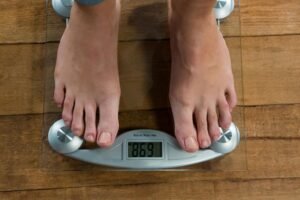
BMI Categories for Adults
For adults aged 20 and older, BMI is grouped into four standard categories:
| BMI | Category |
|---|---|
| Below 18.5 | Underweight |
| 18.5 \u2013 24.9 | Healthy weight |
| 25.0 \u2013 29.9 | Overweight |
| 30.0 and above | Obesity |
These are the standard adult categories used by the CDC. Remember, BMI is a screening measure, not a diagnosis \u2014 it’s one data point, not a verdict on your health.
BMI for Children and Teens
These adult categories are not meant for children or teenagers. For ages 2 through 19, BMI is interpreted differently \u2014 using BMI-for-age percentiles rather than fixed cutoffs.
Because kids’ bodies change so much as they grow, a healthy BMI at age 8 looks very different from a healthy BMI at age 16. The CDC compares a child’s BMI to others of the same age and sex to find where they fall on a growth chart. If you have questions about a child’s growth, a pediatrician is the best person to ask.
Why BMI Matters
Despite its limitations, BMI remains a useful first-pass screening tool. On a population level, higher BMI is associated with increased risk of certain health conditions, including heart disease, type 2 diabetes, and high blood pressure.
That’s an association, not a guarantee \u2014 a high BMI doesn’t mean someone has or will develop any of these conditions, and a healthy BMI doesn’t guarantee their absence either. What BMI offers is a quick, free, equipment-free way to flag when it might be worth looking at your health a little more closely.
When BMI Doesn’t Tell the Whole Story
BMI has one major limitation: it doesn’t measure body fat directly. It only looks at height and weight, which means it can be misleading in some common situations:
- Muscular people \u2014 someone with significant muscle mass can have a high BMI despite very low body fat, since muscle is denser than fat.
- Pregnancy \u2014 a growing baby naturally raises weight and BMI in ways that don’t reflect health risk, so standard BMI interpretation doesn’t apply during pregnancy.
- Older adults \u2014 muscle loss with age can leave someone with a “normal” BMI despite a higher body fat percentage, so BMI should be read alongside other markers later in life.
Body composition itself can be measured more directly \u2014 through methods like waist circumference, DEXA scans, skinfold calipers, or bioelectrical impedance (BIA) scales. These vary in cost, accessibility, and precision, and most people don’t need them just to get a general sense of their health.
BMI and Ethnicity
BMI doesn’t reflect cardiometabolic risk equally across every population. Research shows some ethnic groups can face increased health risks \u2014 such as type 2 diabetes \u2014 at BMI levels that would still fall in the “healthy weight” range on the standard chart.
In the UK, NICE guidance uses lower, practical BMI thresholds when assessing overweight and obesity in people from South Asian, Chinese, other Asian, Middle Eastern, Black African, and African-Caribbean backgrounds:
- BMI 23\u201327.4: overweight threshold for these specific populations
- BMI 27.5 or higher: obesity threshold for these specific populations
These thresholds apply specifically to the populations above \u2014 they’re not a general replacement for the standard categories, and they’re not a rule that applies uniformly to every individual within these broad groups. If you’re unsure how this applies to you, it’s worth a conversation with a healthcare provider who knows your background and health history.
What Should You Do With Your BMI Number?
Treat your BMI as one piece of information, not the whole picture. It’s worth looking at alongside your overall habits, waist measurement or body composition, family health history, energy levels, and any other risk factors you’re aware of.
A single number outside the “healthy” range isn’t something to panic over \u2014 small, sustainable changes over time matter far more than any one measurement. If you’re genuinely concerned about your weight or health, the most useful next step is a conversation with a qualified healthcare professional who can look at your full picture, not just one number.
Calculate Your BMI Today
Ready to see where you stand? Use our free BMI Calculator to get your number instantly \u2014 no maths required.
Understanding your BMI is one small, useful step toward making informed decisions about your health.
Frequently Asked Questions
What is a healthy BMI for adults?
For most adults, a BMI between 18.5 and 24.9 is considered a healthy weight range. This can vary slightly depending on ethnicity and individual health factors.
Is BMI accurate?
BMI is a reasonably useful screening tool for most people, but it doesn’t measure body fat directly, so it can be misleading for athletes, older adults, and during pregnancy.
Is BMI different for children?
Yes. Children and teens (ages 2\u201319) are assessed using BMI-for-age percentiles rather than the fixed adult categories, since healthy BMI changes a lot as kids grow.
Can you have a healthy BMI and still have excess body fat?
Yes. Because BMI doesn’t measure body fat directly, it’s possible to have a “healthy” BMI while still carrying a higher body fat percentage, particularly with low muscle mass.
Should BMI be used during pregnancy?
No. Standard BMI interpretation isn’t appropriate during pregnancy, since weight gain is a normal and necessary part of a healthy pregnancy. Talk to your healthcare provider about healthy weight ranges during pregnancy.
Medical Disclaimer
This article is for general informational purposes only and is not a substitute for professional medical advice. Please see our medical disclaimer or consult a healthcare professional for guidance specific to you.

Busy professionals sharing practical wellness tips that fit a real schedule. No extreme routines - just honest habits from experience.
About UsYou May Also Like



Found This Helpful?
We share practical wellness tips every week — no fluff, no perfection required. Just real habits for real busy people.